Frequently Asked Questions
Q: Where will workshops be held?
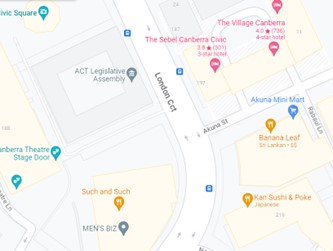
Workshop locations will be published on the commissioning website and on the Eventbrite registration pages, however, all workshops are currently being held at the ACT government building at 220 London Circuit in the city.
Please note: The building can be accessed via the below marked point, with all Rapid buses stopping at the surrounding bus stops.
Q: Will workshops have a hybrid option?
Workshops are not planned to have a hybrid option. The mental health commissioning team feel that it is important that we engage in these conversations face to face. However, we hope that other consultation activities such as the YourSay survey, feedback papers and discussion guides will provide feedback and consultation opportunities for those who don’t want to or cannot come to an in-person workshop.
If we do receive larger numbers of registrations than the in-person workshops can cater for, we may attempt to hold additional workshops for people on the waiting lists.
Q: How can I make sure I hear about workshops and consultation opportunities?
The workshop calendar will be published on the commissioning website. We will also send regular emails to the commissioning mailing list – we have automatically added anyone who has attended this webinar to our mailing list, however if you wish to be added to this list and might be listening to the recording please email us at mentalhealthcommissioning@act.gov.au
Q: Why is the timeframe for consultation activities so short?
It was important that our team took the time to make sure we were able to plan and design our engagement and write the blueprint so that we could have more productive consultations. While we know that the timeframe is short, we have a dedicated team who are working their hardest to gather your input and consolidate this into the Investment Strategy to guide our Invest phase.
Q: Can I reach out to the team for a 1:1 meeting to discuss my concerns?
We are happy to receive emails at any time through the design phase and we will do our best to accommodate any individual conversations people may wish to have. However, if the conversation is about a topic already covered by a workshop, feedback paper, or the blueprint, we would encourage you to attend or review the relevant consultation activity if possible, as we will only have limited time for 1:1 meetings.
Q: If I can’t make the workshop date is there a way for me to contribute to the discussion?
Completing the survey on YourSay or reviewing and providing feedback on the feedback papers and discussion guides are the best ways for you to contribute outside of workshops.
Q: When will be find out about the investment strategy?
We anticipate the investment strategy will be announced in the third quarter of 2023.
Q: Will there be any more consultations after these ones?
After the Design phase, there will be no more public consultations for probity reasons as we progress in to the Invest phase.
Q: When will procurement for new services start?
The expected timeline will be outlined further in the Investment Strategy. Depending on internal Government processes, we anticipate that procurement will begin towards the end of 2023 and be open for a number of months.
Q: My service doesn’t fit into the Initial Assessment Referral (IAR) tool – does this mean that it won’t be included in the commissioning process?
No – one of the reasons for us doing this consultation is to find out if the way we have categorised services through the IAR is appropriate. We are using the IAR as a model to guide our thinking, but we recognise that it does have shortcomings in this process. This is why, for example, we have created the additional ‘Level 0’ in our Blueprint. If you have any additional feedback on the IAR, and whether you think any relevant services don’t fit in it, please email us.
Q: Have you been in touch with other areas doing commissioning as part of this process?
Yes, we have engaged with all other NGO commissioning areas of ACT Government and will continue to do so through the design phase. We will be holding an internal cross-government workshop in the Design phase. We also welcome government feedback through all other formats including the blueprint, feedback papers, and workshops.
Q: My organisation doesn’t have resources to participate in commissioning activities – will there be any support for us to participate?
Unfortunately, organisations cannot be financially supported at this stage. This is why we have proposed a range of in-person and online consultation activities for the Design phase, including feedback papers which will be open for feedback over the whole Design phase. We also hope that the Discussion Guides that we will prepare, to accompany the Feedback Papers, will help to facilitate feedback through conversations that can occur as part of regular team meetings or organisational activities. This feedback can then be emailed through to us.
Additionally, outside of our Commissioning process, Mental Health Policy and Strategy are holding a series of service visits to our currently funded providers as part of regular Contractual obligations. For these providers, this will be an opportunity to discuss any of your input about the Design phase.
Q: Are you expecting to use open competitive tendering, or will the process be more selective?
The approach to procurement will be outlined in our Investment Strategy released later this year. We expect that this procurement process will include a mixed methodology, but this will be detailed in the Investment Strategy.
Q: In the Blueprint, it states that you will be incentivising innovation to deliver outcomes. What do you mean by that? How will you incentivise?
In this Design phase we will be consulting with the sector to define the Outcomes we want our funded NGO sector to work towards. When we procure these services, a significant component of this will be asking providers how they can contribute to these through their programs. We hope that this will encourage innovation within our sector, as it gives providers more space and flexibility to show the breadth of services they can offer to meet these outcomes. The tenders that can most effectively demonstrate a plan to meet these outcomes will be the more successful tenders in this procurement process.
Q: In that timeline, when do you expect the next tender for services will open and close?
This will be further outlined in the Investment Strategy, however we hope to release tenders in multiple stages so that we are not overwhelming the market all at once. While we don’t have a date for these phases yet, we will communicate this openly through our channels once the Investment Strategy is published so that providers have notice for these timeframes.
Q: How is it recovery focused, but also focused on prevention and early intervention?
We are using ‘recovery focused’ to describe, not just the absence of symptoms or clinical recovery, but rather as a rights-based approach to the delivery of all mental health services. We have taken our guidance on a recovery focused approach from the National Framework for recovery-oriented mental health services[1].
This Framework identifies the defining characteristics of a recovery oriented mental health service include:
- developing and drawing on their own expertise and resources as well as the experiences and resources of people with lived experience of mental health issues;
- supporting people as they take responsibility for and reclaim an active role in their life, mental health and wellbeing;
- supporting people to embrace their strengths, resilience and inherent capacities for living a full and meaningful life of their choosing;
- supporting local communities to accept, welcome and include people with mental health issues;
- embracing and enabling people with mental health issues, their families and their communities to interact and draw benefit from one another; and
- recognising the possibility that anyone accessing the service may have a limited experience of unresolved trauma underlying their mental distress and that recovery evolves from the lived experience of trauma as well.
This recovery focus applies across the whole of the mental health service system, including for prevention and early intervention services.
Q: How will you determine who is invited to the workshops when it comes to lived experience
We are working closely with the ACT Mental Health Consumers Network (MHCN) and Carers ACT to incorporate lived experience throughout the Design Phase. As we look towards lived experience workshop and webinar, MHCN and Carers ACT will invite their networks and stakeholders but anyone is welcome to register attend, however spaces will be limited.
We currently have a mailing list, which is where we will send out all of our workshops information and provide opportunities for registering interest. If you would like to be added to this, please contact the mental health commissioning team at mentalhealthcommissioning@act.gov.au
We will also list these workshops via this website, for registration via Eventbrite.
1: https://www.health.gov.au/sites/default/files/documents/2021/04/a-national-framework-for-recovery-oriented-mental-health-services-policy-and-theory
Page updated: 28 Feb 2024